What Happens When You Try to Grow Something After Grief
2024
Index
Role
UX Designer/ Researcher
Status
Redesign in Progress
Company
Bloom
Category
UX Design, AR
TL;DR
The Challenge
The mindfulness app market is worth $2B+ and growing, yet retention is its defining failure. Most users abandon gratitude apps within weeks. The reason is structural: every app gives you a text box. Nothing gives you something physical, alive, and ambient to return to.
My Output
An AR mindfulness app where users plant virtual gratitude notes as 3D plants in their physical spaces. Plants grow over time, respond to affirmations, and live on your home screen as emotional companions.
Impact
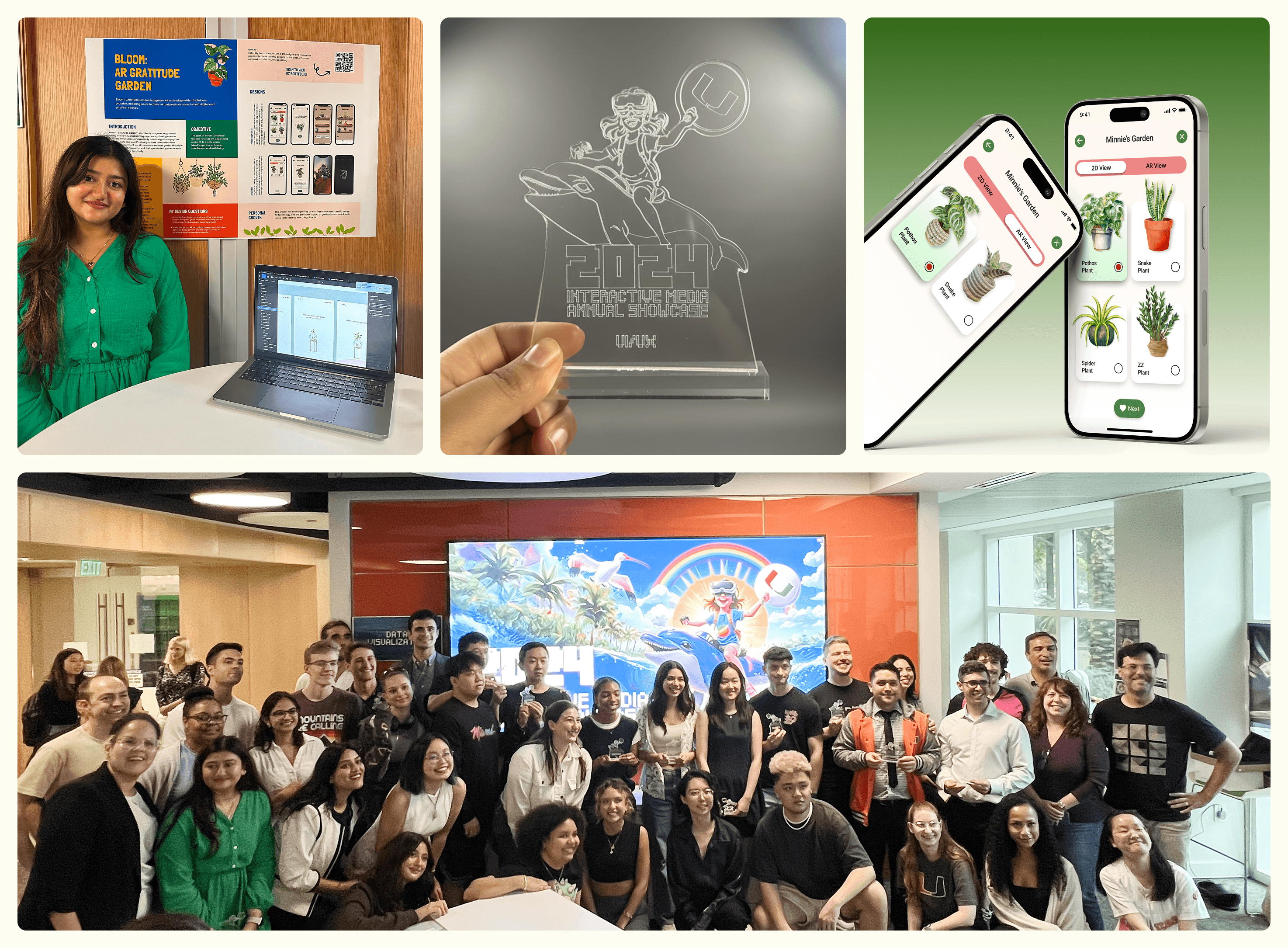
Won Best UI/UX at the University of Miami Annual Showcase 2024. Attendees proposed new features unprompted — a signal the concept resonated beyond the room.
The Honest Truth
The idea is bigger than what was built. This case study shows what exists, what was designed but not developed, and what Bloom is becoming, because I'm rebuilding it now, as a real iOS app.
01 — The Origin
This did not start as a design brief.
A month after moving to the United States, I was in an accident. I will leave it at that.
What I will say is that I arrived in Miami ready for something new, and very quickly found myself trying to hold onto anything that felt like joy.
I tried keeping HOUSEPLANTS.
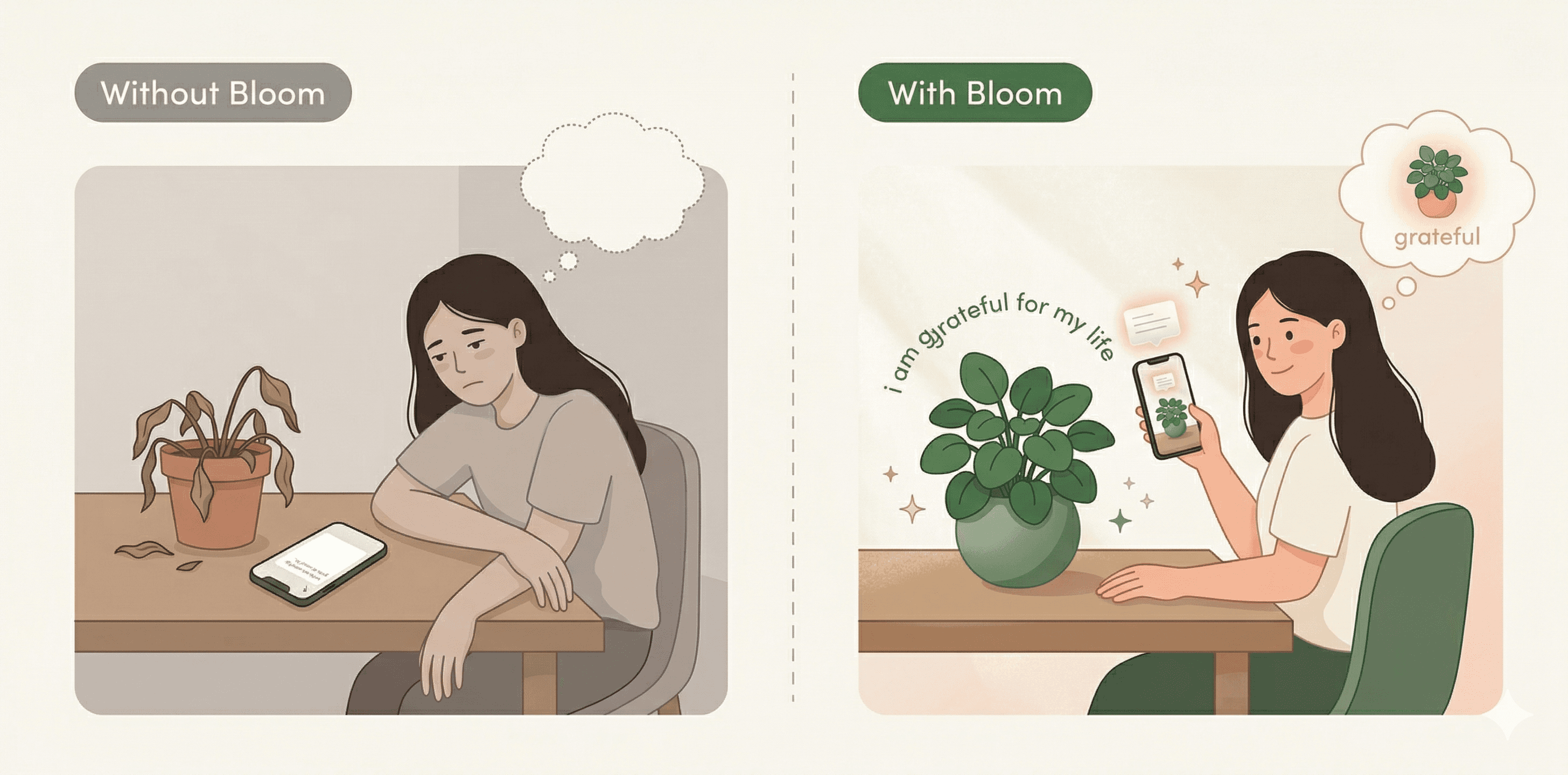
I thought having something alive around me would help; something to tend to, something that needed me. Miami's heat had other ideas. The plants died. And I was left trying to feel grateful for anything when gratitude felt like the furthest thing from where I was.
A year passed. I healed. But I had not forgotten what it felt like to need something living to hold onto, something that existed in your space, not just on a screen. Something that grew with you.
When it came time to choose my capstone project, I did not have to think very hard. Bloom was already there, waiting.
Why this matters as a design problem: Personal origin stories are not just emotional framing, they are the fastest path to a real, underserved user need. I was not designing for a persona. I was designing for the person I had been.
02 — The Insight
Gratitude apps give you a text box. Nothing more.
Before designing anything, I ran a mixed-methods research study: a survey and follow-up interviews across 20–30 participants. To understand people's real relationship with mindfulness and gratitude apps.
The responses were mixed: some found existing apps genuinely helpful, others had abandoned them within weeks. But one pattern held across almost every response:
Apps weren't failing because people didn't want to practice gratitude.
They were failing because nothing made them come back.
The market gap: The global mindfulness app market is projected to exceed $4B by 2027. Yet churn is the industry's defining problem. Calm and Headspace both report significant drop-off after the first month. The category is saturated with well-designed text journals and completely empty of anything spatial, ambient, or alive. No competitor puts gratitude in your physical world. That gap is where Bloom lives.
What participants said:
"I regularly use mindfulness apps to manage stress, but I always forget to open them." -P12-P2
"I didn't know we could use AR for something like planting gratitude — it sounds amazing." -P8
"I would love to see my AR plants around me. It would be really motivational."
The insight was simple: text disappears. A plant on your desk does not. What if gratitude had a physical presence? something you walked past every day, something that grew when you tended to it and needed you when you did not?
03 — The Goals
Product Goals
Improve daily return rate vs. text-only competitors
Validate spatial, ambient design as a retention mechanic
Prove AR can serve emotional wellness, not just gaming
Build a concept strong enough to develop as a real product
User Goals
Make gratitude feel tangible, not just written
Build a daily habit without pressure or streaks
Have something living in their space to return to
Express gratitude in a way that feels personal
Feel a sense of growth alongside their plants
Design Goals
Blend AR seamlessly into a daily mindfulness habit
Make 3D plant creation feel magical, not technical
Design an onboarding that sets a calm, open tone
Express gratitude in a way that feels personal
Use AI to help users express gratitude more deeply
04 — Key Design Decisions
Decision 1: The onboarding breathing exercise.
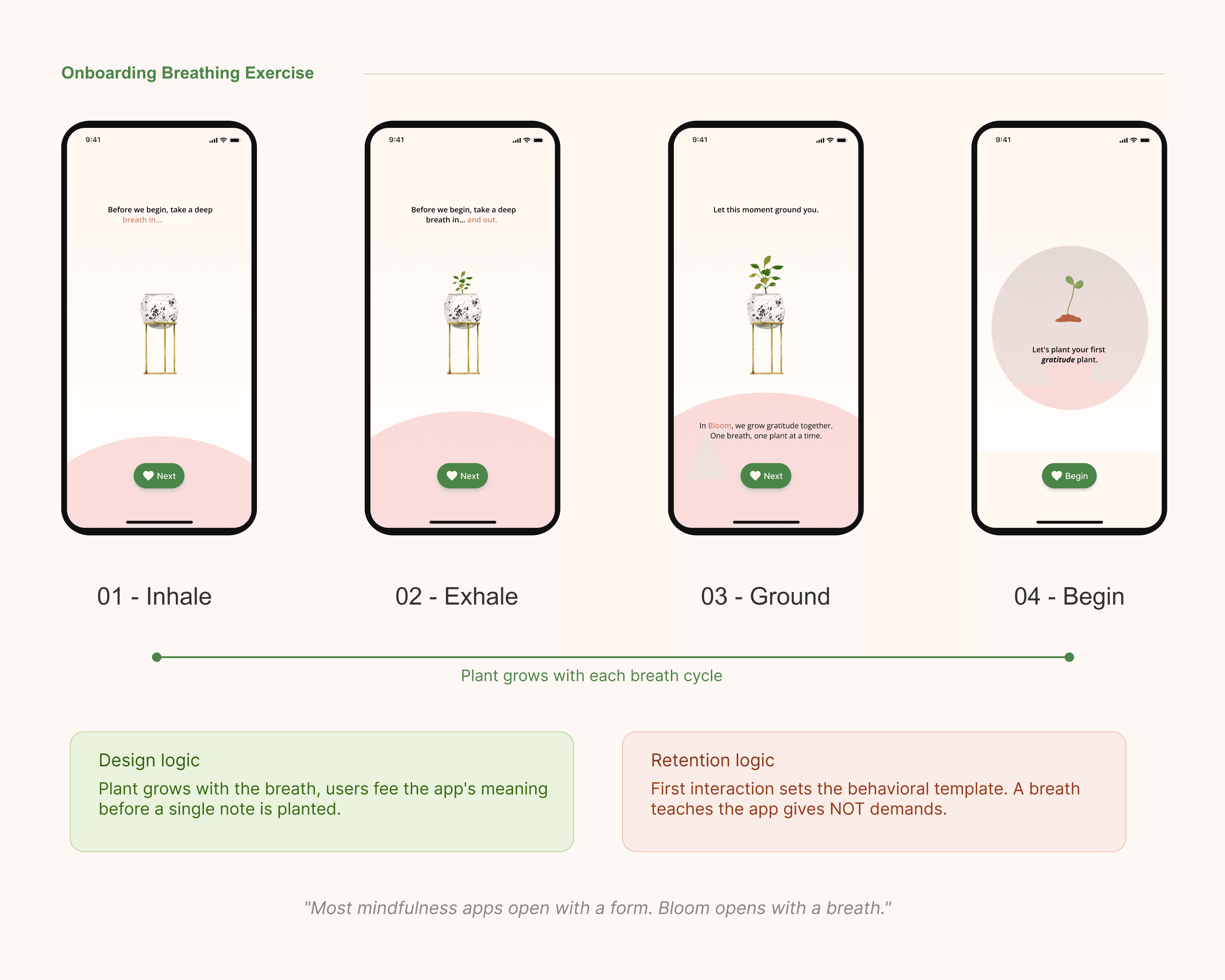
Most mindfulness apps open with a wall of questions or a feature tour. Bloom opens with a breath.
The onboarding begins with a simple breathing exercise — inhale, exhale — and as the user breathes, a plant grows on screen with them. Before a single gratitude note has been planted, the user already has a felt sense of what the app is about: growth, slowness, presence.
This was also a deliberate retention decision. Research on habit formation shows that the first interaction with an app sets the behavioral template. If your first experience is a form, you learn the app requires effort. If your first experience is a breath, you learn the app gives you something. Bloom needed to give first.
Decision 2: Planting gratitude in your actual space.
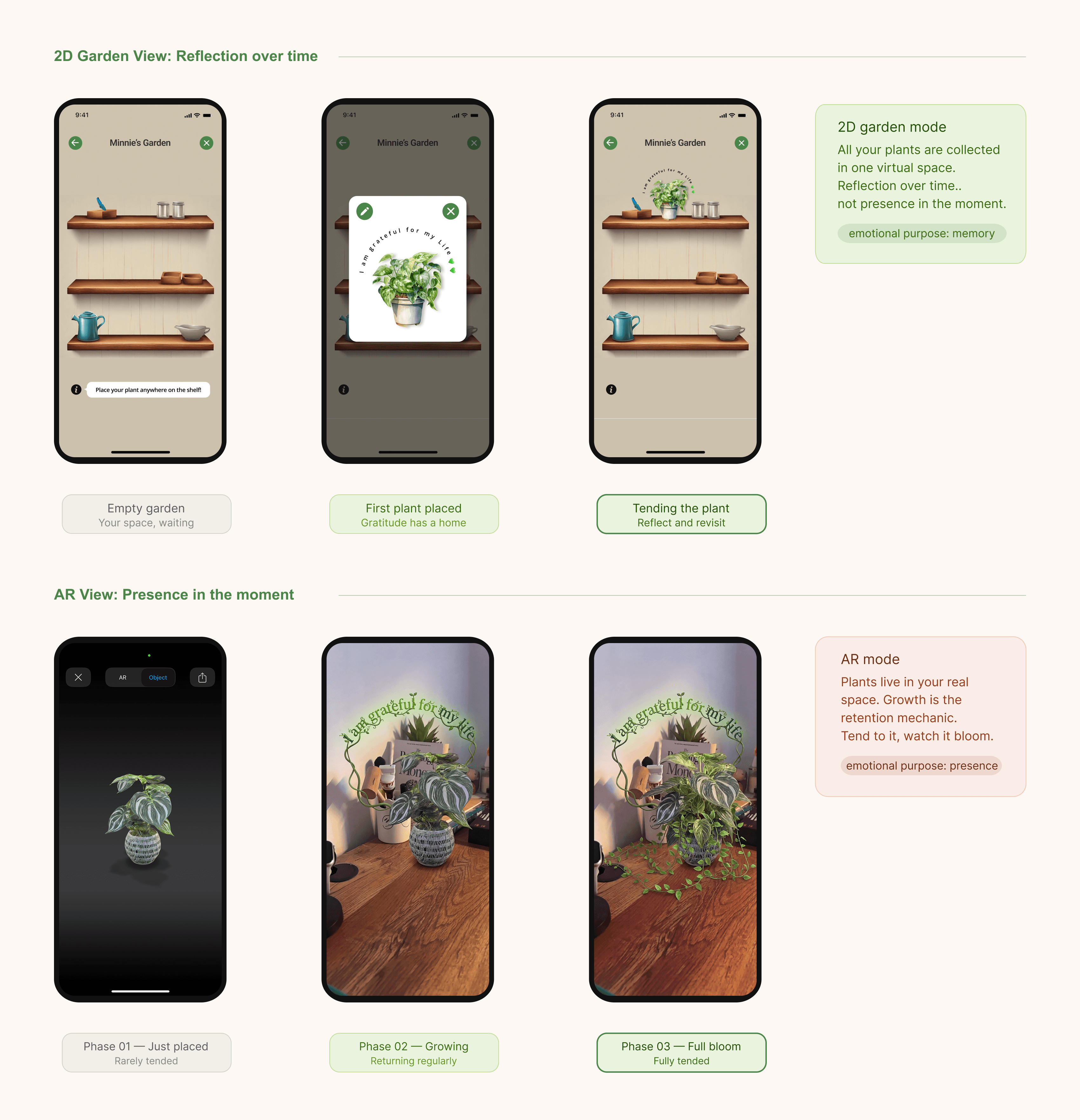
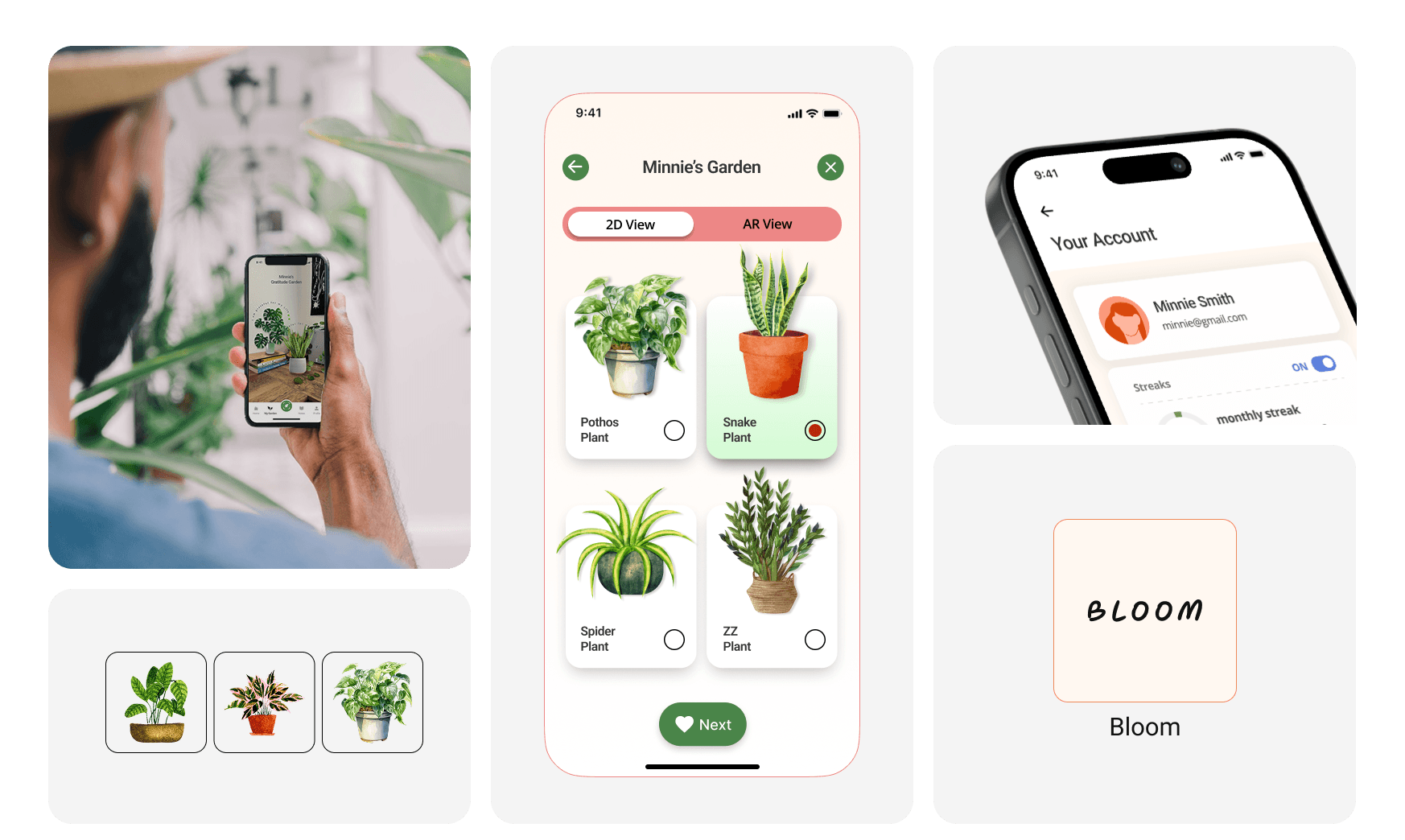
The core interaction is simple: open the app, select a plant, write what you are grateful for, and place it somewhere in your physical world using AR.
Point your camera at a surface: your desk, your windowsill, your kitchen counter and tap to plant.
The gratitude text floats above the 3D plant, visible whenever you look at that spot through the app. The plant is yours. The space is yours. The gratitude lives where you live.
The AR experience has two modes: AR view, where plants exist in your real environment, and 2D Garden view, where all your plants collect in a virtual space you can visit anytime. Both serve different emotional needs — presence in the moment, and reflection over time.
The design logic: Ambient presence is the mechanic most missing from wellness apps. By making gratitude spatial, Bloom doesn't compete for screen time it becomes part of the environment itself. That's a fundamentally different retention model than push notifications.
Decision 3: 3D plants directed with AI.
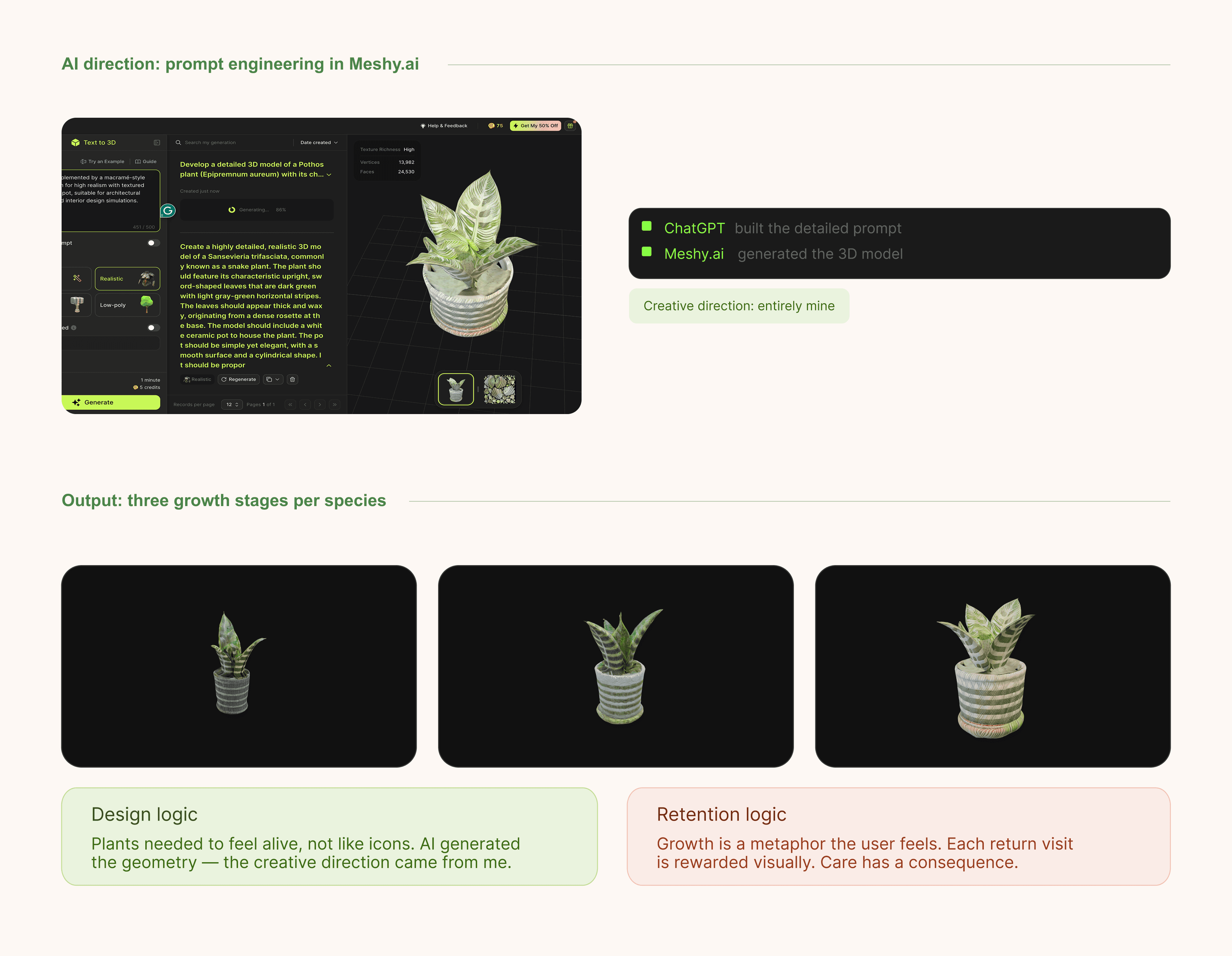
[ Image: Phase 01 / 02 / 03 plant growth stages — small sprout, medium, full grown ]
The plants needed to feel alive, not like icons. I used Meshy.ai to generate 3–5 species — but the creative direction came entirely from me. I used ChatGPT to first build detailed prompts: species, size, mood, level of detail. Then I fed those into Meshy.ai and iterated until each plant felt right.
Each species has three growth stages — small, medium, full grown — representing the user's deepening relationship with that gratitude note over time. The plant grows as the user tends to it. Neglect it and it stays small. Return to it, and it reaches its full size.
The growth is not just visual. It is a metaphor the user feels — and a mechanic that creates genuine reason to return.
Decision 4: The emotional widget.
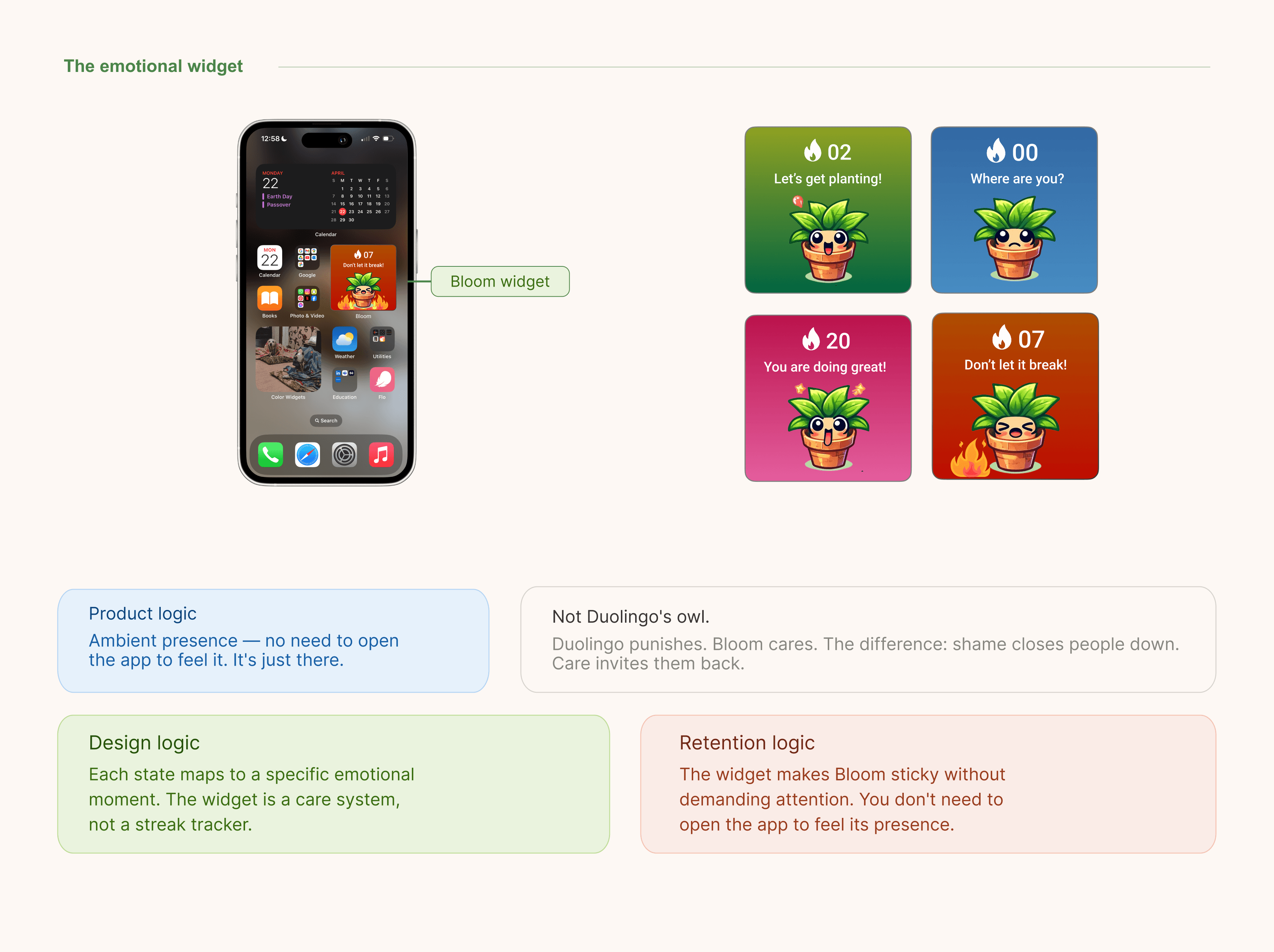
Bloom lives on your home screen, not just inside the app. The widget shows a plant avatar with an emotional state that changes based on your activity — similar to how Duolingo's owl reacts to your streak, but warmer. Less guilt, more care.
Tend to your plants regularly and the avatar is happy, vibrant, full of life. Go a few days without and it gets droopy — a gentle nudge, not a punishment. The difference matters in emotional wellness design: shame closes people down. Care invites them back.
The product logic: The widget is the ambient layer that makes Bloom sticky without demanding attention. You don't need to open the app to feel its presence. It is simply there a small thing that needs you, in the nicest possible way.
05 — Built vs. Designed
Honest about the gap.
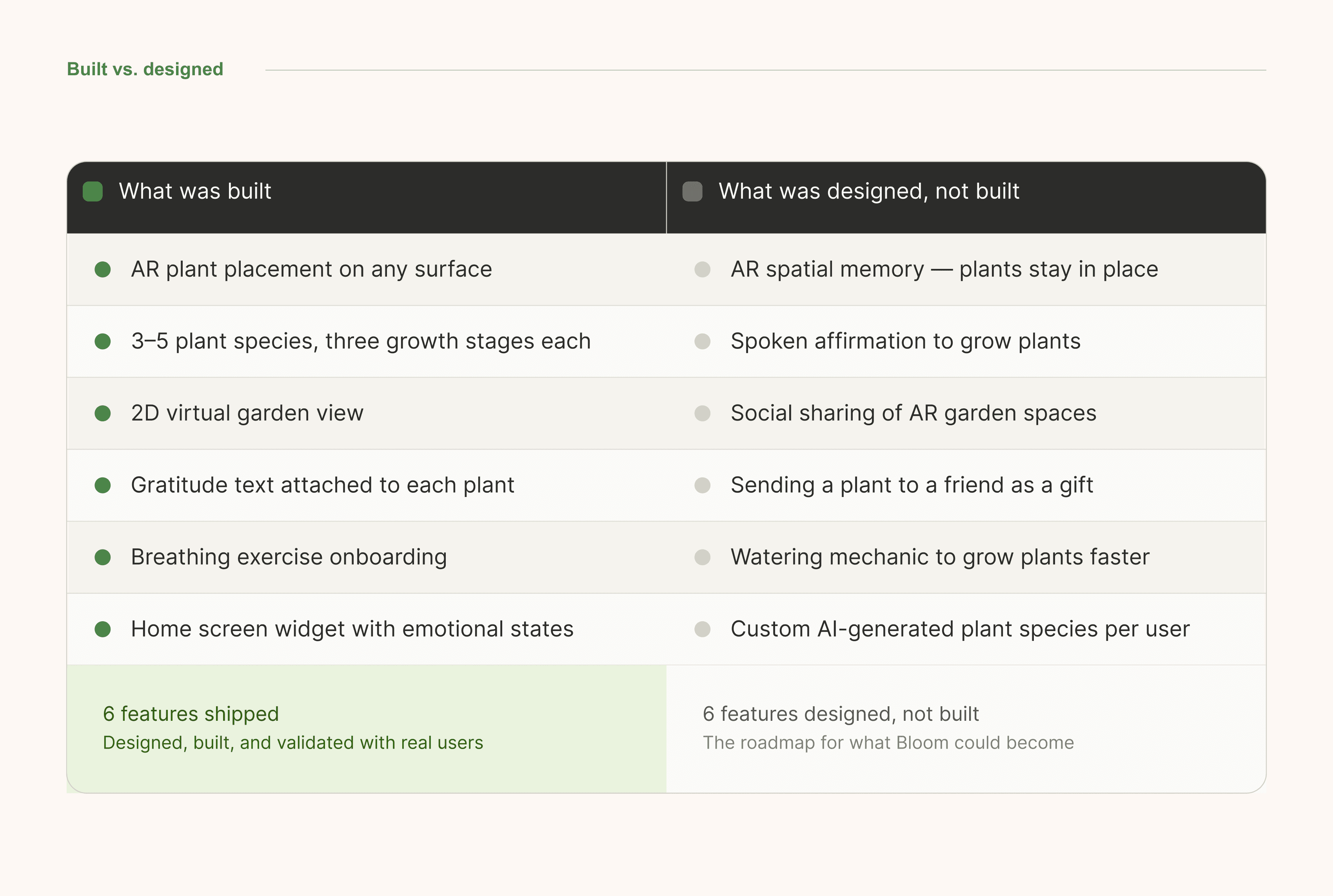
I led all design and provided detailed specs to a development partner who executed the build. Not everything designed made it into the prototype — and that is worth being transparent about.
The gap between designed and built is not a failure — it is the natural reality of a capstone project. What matters is that the designs were fully realized, the interactions were prototyped, and the concept was validated by real users.
For anyone reading this as a portfolio piece: I can articulate exactly what I would build first, why, and how I would measure whether it worked. That is the more important signal.
I am not waiting this time.
Bloom won an award as a student project. Now I am rebuilding it as a real iOS app — and this time, I am closing the gap between designer and builder myself.
Over the past year I have been learning to vibe code using Claude, starting with simple projects and working toward more complex builds. I have integrated Claude with Figma via MCP, which means the next version of Bloom will be designed and built with intention from the same workflow. The redesign is my next move: every color, every interaction, every piece of copy will have a reason rooted in the emotional purpose of the app.
Features I am prioritizing for the rebuild, and why:
AR spatial memory: Plants stay exactly where you placed them across every session. Your desk becomes a permanent garden. This is the single highest-leverage feature for transforming Bloom from a novelty into a habit.
Send a plant to a friend: Gift someone a gratitude note that grows in their space. Grief and gratitude are not solo experiences — and this is the feature most likely to drive organic word-of-mouth.
Custom AI plant species: Describe your mood and the AI generates a plant unique to that moment. No two gratitude notes look the same. This is where the AI layer becomes emotionally meaningful, not just functional.
Watering mechanic: Return to a plant, water it, watch it grow. The simplest possible loop for building a daily habit.
Deeper onboarding: The breathing exercise is just the beginning. The full vision is an onboarding that gives users a complete felt experience of what Bloom means before a single note is planted.
The original Bloom was built with a development partner from my specs. The next one will be built by me — with better design judgment, a cleaner AI workflow, and a much clearer sense of what this product is actually for.
08 — Reflection
What I carried out of this project.
Bloom taught me that the best design problems are the ones you have lived. Not because personal experience makes you biased — but because it makes you specific. I was not designing for a persona. I was designing for the person I was in my first semester, sitting in a Miami apartment with dying plants and a healing hand.
That specificity is what made it resonate. People felt it because it was real.
The technical growth was real too: AR interaction design, 3D asset direction using AI tools, emotional design systems, and the discipline of knowing when to stop adding and start simplifying. But the biggest thing I learned was this:
"Design is most powerful when it comes from something true."
Bloom is still growing. So am I.